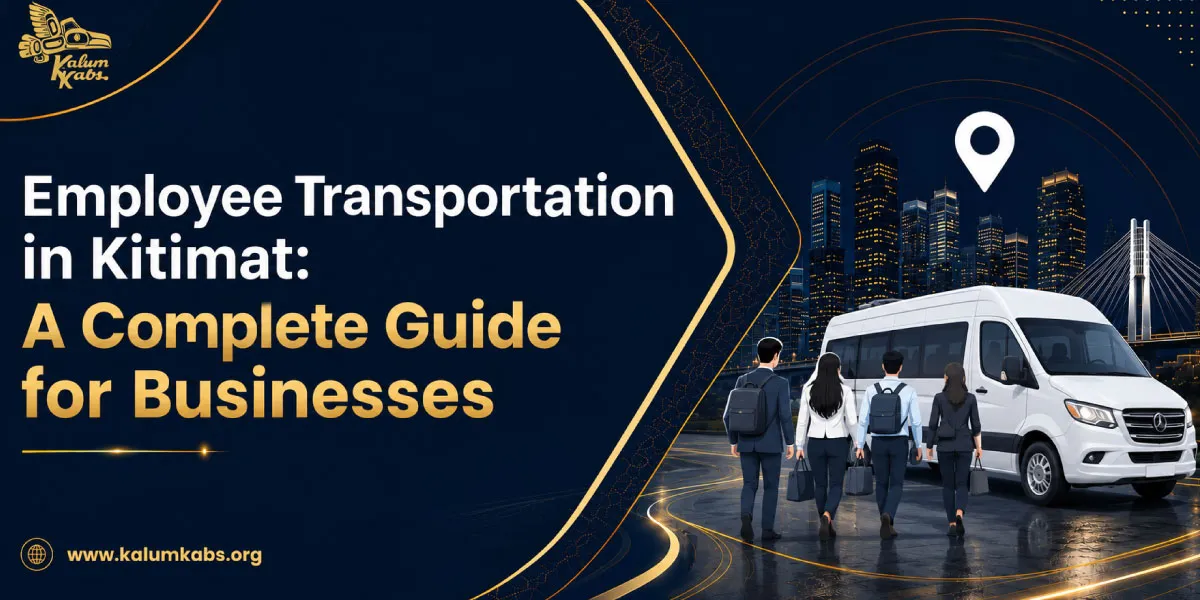
Employee transportation in Kitimat is a daily operational question for almost every employer in the district, not a side issue for the HR department.
Reliable transportation matters here for a simple reason: when a crew cannot get to work, production stops.
A plant turnaround that is short six millwrights, a camp kitchen without its morning staff, or a retail store that opens late because the highway was closed all have the same root cause.
The 63-kilometre stretch of Highway 37 between Terrace and Kitimat receives the highest winter maintenance classification in British Columbia. However, winter travel can still be challenging, with snowfall, freezing rain and road advisories affecting daily commutes. Historical climate data shows that snowfall accounts for approximately 23% of annual precipitation in Kitimat, highlighting the importance of preparing for winter driving conditions. Travel advisories, single-lane traffic and snowfall warnings can make employee transportation more challenging between November and March.
For companies bringing in contractors and technical staff through the Northwest Regional Airport, well-run corporate travel services also close the gap between an arriving flight and a camp bed or a job site.
This guide explains what employee transportation is, why it matters in Kitimat specifically, the challenges local employers face, the service types available, what the service costs, how to choose a provider, and when it is time to move from informal arrangements to a professional employee transportation service.
It is written for operations managers, HR directors, project managers, site superintendents and business owners who need a dependable answer to one question: how do we get our people to work?
What Is Employee Transportation?
Employee transportation services are scheduled, employer-arranged passenger transport that moves staff between their homes, accommodation, transit hubs or airports and their place of work.
The employer, not the individual employee, sets the schedule, defines the pickup points and pays for the service, usually under a contract or monthly account rather than trip by trip.
➔ Businesses use these services in several ways:
⮞ Fixed-route commutes
A shuttle collects staff from set stops in Kitimat or Terrace and delivers them to a plant, mill, port or office at shift start, then returns them at shift end.
⮞ Shift coverage
Rotating day and night crews are moved on a repeating timetable that matches the shift calendar rather than public transit hours.
⮞ Camp and site transfers
Workers housed in workforce accommodation are moved between the camp, the work site and the airport on arrival and departure days.
⮞ Airport transfers
Contractors, engineers and visiting management are met at the Terrace airport (YXT) and driven to Kitimat without needing a rental car.
⮞ On-demand corporate accounts
Staff who need an occasional ride for a meeting, medical appointment or late finish charge the trip to a company account instead of paying personally.
The difference between employee transportation and a regular taxi is mainly one of planning and accountability. A taxi is dispatched one trip at a time, to one passenger, at a price set per trip.
Corporate employee transportation is planned in advance around a workforce schedule, uses vehicles sized to the group (a six-seat minivan or a 22-seat shuttle rather than a sedan), runs on a repeating timetable, and is billed to the business on terms the business agreed to.
Many local employee transportation companies operate both models side by side.
For employers, the practical advantage is a single local point of contact for everything from a one-off airport pickup to a year-round shift schedule.
Why Is Employee Transportation Important for Businesses in Kitimat?
Kitimat’s economy is unusually concentrated in a handful of large industrial operations.
The District of Kitimat lists Rio Tinto’s BC Works smelter, which the Kitimat Modernization Project expanded to roughly 420,000 tonnes of aluminum a year, alongside the LNG Canada export facility and its Cedar Valley Lodge workforce accommodation.
LNG Canada’s Phase 2 expansion is expected to bring up to 4,000 construction workers to the site at peak, and the Haisla-led Cedar LNG project reported in its spring 2026 newsletter that it was heading into peak construction with the floating facility more than half complete.
Every one of those projects depends on moving people, and the pressure flows down to the suppliers, contractors, hotels, restaurants and service businesses that support them. The following sections explain the specific operational benefits.
❏ Reliable Employee Commutes
A commute that depends on each worker’s own vehicle is only as reliable as the least reliable vehicle, driver and road.
In Kitimat, where a large share of the workforce lives in Terrace or Thornhill and drives Highway 37 twice a day, one stalled truck at Onion Lake can delay dozens of employees at once.
A scheduled shuttle operated by a company with 24/7 dispatch, GPS-tracked vehicles and local drivers who know the road removes much of that variability. The provider monitors DriveBC conditions, adjusts departure times, and chooses the vehicle class suited to the weather.
Reliability also means consistency across the year.
Public transit between Terrace and Kitimat exists, but BC Transit’s Route 11 Terrace-Kitimat Connector operates Monday to Saturday on a fixed timetable that was designed for general ridership, not for a 6:00 a.m. plant shift or a Sunday turnaround.
An employee transportation service built around the company’s own calendar fills that gap.
❏ Improved Employee Punctuality
Late arrivals cost more than the minutes lost. In continuous-process operations such as a smelter or an LNG train, a shift handover that runs late holds the outgoing crew on overtime and compresses the safety briefing for the incoming one.
When a dedicated shuttle delivers the whole crew at 5:45 for a 6:00 start, the supervisor gets a complete, punctual team rather than a trickle of arrivals over twenty minutes.
Punctuality improves for a second reason: the shuttle leaves on time whether or not every individual is organised that morning. Employees adapt to the pickup schedule in a way they rarely adapt to their own alarm clock.
Many employers find that lateness disputes drop sharply once transportation is scheduled rather than left to individuals.
❏ Reduced Transportation Challenges
Site parking is one of the quietest constraints on an industrial site. A plant designed for 400 operating staff that suddenly hosts 1,500 contractors during a shutdown has nowhere to put the vehicles.
Shuttles and crew vans collapse that demand: one 22-seat shuttle replaces up to twenty-two parking spaces and twenty-two sets of vehicle movements through a security gate.
Fewer private vehicles also mean fewer incidents in the parking lot, less road wear on access roads and less snow clearing.
Employee transportation solutions also simplify the administrative load. Instead of processing dozens of mileage claims or managing a pool of company trucks, insurance, fuel cards and maintenance schedules, the business receives one invoice per month from one provider.
Bundling the daily commute with the company’s wider corporate travel services, such as airport runs and inter-office trips, reduces the administrative load further.
❏ Better Workforce Productivity
An employee who spends ninety minutes a day driving a winter highway arrives tired and leaves tired. The same employee riding a shuttle can rest, eat, check messages or complete pre-shift paperwork.
Over a two-week rotation the difference in fatigue is measurable, and fatigue is a leading contributor to both safety incidents and quality errors in heavy industry.
Productivity also improves at the management level. Supervisors who no longer spend the first half hour of each shift chasing missing staff, reallocating tasks and calling people who are stuck on the highway can focus on the work plan.
Project managers can commit to crew counts with contractors knowing the transportation side is handled.
❏ Support for Remote Work Locations
Many Kitimat-area work locations are not in town at all. Marine terminals, the Kemano powerhouse access points, pipeline right-of-way sections, logging blocks and construction laydown yards are reached by industrial roads that family cars are not built for.
Transportation providers with experience on Northwest BC highways, industrial corridors and remote roads carry the right vehicles, communications equipment and local knowledge to reach those locations safely and on schedule.
For employers, this is the difference between hiring only people who happen to own a capable 4×4 and hiring the best candidate for the job regardless of what they drive.
Also Read: Corporate Transportation in Terrace: A Complete Guide for Business Travelers
Common Employee Transportation Challenges in Kitimat
The challenges below are specific to the district and the wider Terrace-Kitimat corridor. Any employee transportation management plan for the area has to account for all five.
✦ Limited Public Transportation Options
Kitimat has a conventional local transit system, handyDART service and the regional Route 11 connector to Terrace. These are useful for residents but have real limits for employers.
According to the provincial Highway 16 transportation options sheet, the Terrace-Kitimat Connector runs Monday to Saturday only, and local routes do not serve industrial sites outside the town grid.
There is no Sunday regional service, no overnight service and no service tailored to a 12-hour shift pattern.
For any operation running continuous shifts, public transit is at best a partial solution for a portion of the workforce, which is why most employee transportation companies in the region are asked to fill the gaps around the transit timetable rather than replace it.
✦ Long Travel Distances to Worksites
Kitimat sits 63 kilometres south of Terrace and Thornhill on Highway 37, with the Northwest Regional Airport between the two communities. Workers living in Terrace face a drive of 45 minutes to an hour each way in good conditions, longer in winter.
Those arriving by air need to cover roughly 50 kilometres from the terminal to a Kitimat camp or site.
Multiply that by hundreds of workers and the daily vehicle-kilometres become a major cost, a safety exposure and a source of lateness that employee transportation solutions are specifically designed to absorb.
✦ Harsh Winter Weather Conditions
Winter is the defining operational risk for employee transportation in Kitimat. Storms have forecast up to 50 centimetres of snow for the Terrace-Kitimat area in a single event, closing schools and prompting warnings about dangerous driving.
Local news has repeatedly reported Highway 37 reduced to a single lane near Onion Lake and vehicles in the ditch during heavy snowfall. Freezing rain, blowing snow and limited visibility are regular features of the corridor from late autumn to early spring.
For a business, this means private commuting carries a safety and liability exposure that grows every winter. Professional drivers in well-maintained vehicles, operating under a dispatch system that tracks road conditions in real time, materially lower that exposure.
It also means that the decision to delay or cancel a shift for weather can be made once, centrally, with accurate information, rather than left to each employee at 4:30 in the morning.
✦ Early Morning and Late-Night Shifts
Industrial Kitimat does not keep office hours. Smelter and LNG operations run 24 hours a day, 365 days a year.
Construction and maintenance contractors frequently work 10- or 12-hour shifts starting at 6:00 or 7:00 a.m., with night shifts starting at 6:00 or 7:00 p.m.
These start times fall outside the hours of any transit service and at the edges of when a casual taxi fleet has drivers available.
A corporate travel company that operates 24/7 dispatch and can commit vehicles to a shift pattern in advance is the only reliable option for round-the-clock operations.
✦ Transportation Needs for Large Workforces
During LNG Canada’s first-phase construction, the project employed about 9,000 workers at peak. Phase 2 is expected to bring thousands more.
Large shutdowns at the smelter bring hundreds of additional trades into town for weeks at a time.
Moving groups of that size requires fleet capacity, scheduling systems and dispatch coordination that no individual employer wants to build from scratch for a temporary need.
It also requires a provider that can scale up for a shutdown and scale back down afterward without penalty.
Types of Employee Transportation Services Available in Kitimat
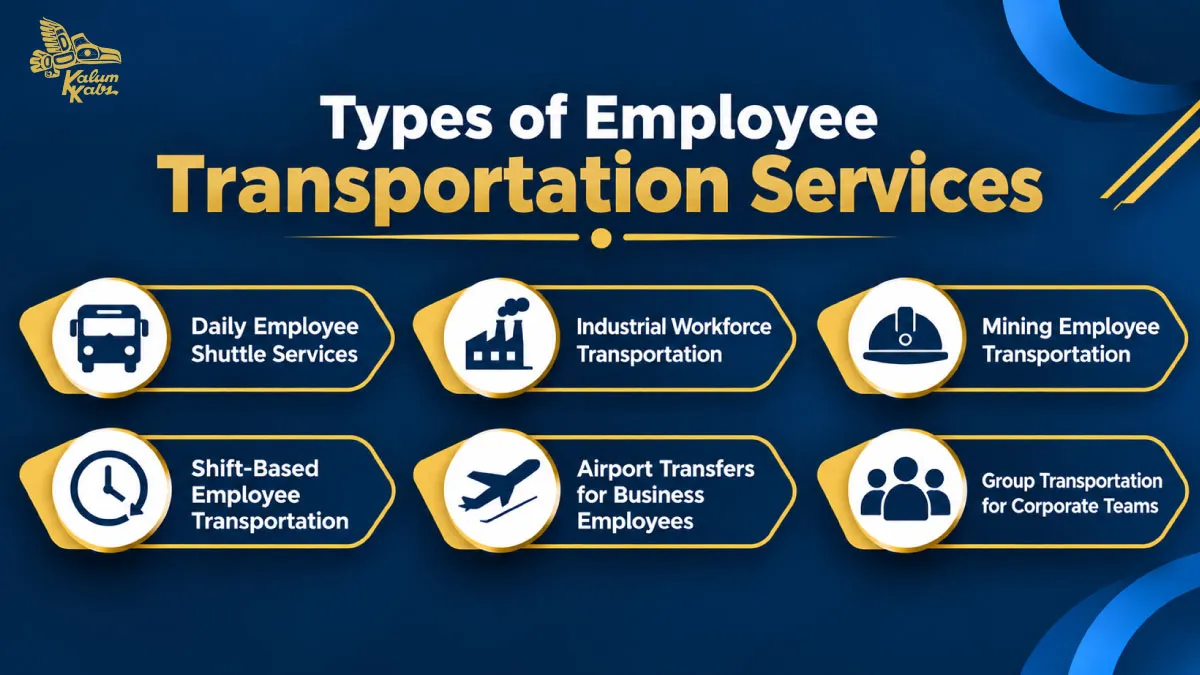
Employers in the district can draw on several distinct service types. Most businesses use a combination, and the mix changes with the season and the project cycle.
➥ Daily Employee Shuttle Services
The daily shuttle is the backbone of office employee transportation and plant commuting alike.
For an administrative office in downtown Kitimat, office employee transportation may be a single morning and evening run; for a plant, it is several runs per day matched to crew changes.
A vehicle sized to the group, typically a minivan for six or fewer or a regional shuttle for groups of six to twenty-two, follows a fixed route with set pickup points and a fixed arrival time at the workplace.
The return trip mirrors it at shift end. Routes are typically designed once, reviewed quarterly, and adjusted as the roster changes.
Shuttles work best when they are integrated with broader corporate travel management services, so that the same provider handling the daily run also handles the visiting auditor’s airport pickup and the team’s trip to a regional meeting in Terrace.
One account, one invoice and one dispatch number keeps administration simple. Providers that offer corporate travel management services alongside shuttles can also report on total travel spend, which helps finance teams budget.
➥ Industrial Workforce Transportation
Industrial workforce transportation differs from a commuter shuttle in its destinations and conditions.
Vehicles travel to plant gates, laydown yards, marine terminals and construction areas, often on gravel or industrial roads, and must comply with site access rules, safety orientations and security procedures.
Providers experienced in industrial workforce transportation build those requirements into the service rather than treating them as exceptions. Project-based arrangements cover short-term contracts, long-term operations, shutdowns and maintenance campaigns.
➥ Mining Employee Transportation
Northwest BC is one of the most active mineral exploration and mining regions in Canada.
The Mining Association of BC’s 2026 Northern BC Economic Impact Study assessed 24 critical mineral, precious metal and steelmaking coal projects in the north, fourteen of them in the Northwest.
Mining employee transportation typically combines airport transfers for fly-in crews with transport to staging points, camps and exploration sites. Rotations are long, schedules are fixed months in advance, and the roads are among the most demanding in the province.
Providers need vehicles suited to the terrain, drivers comfortable on remote routes and the flexibility to adjust when weather grounds a flight.
➥ Shift-Based Employee Transportation
Shift-based transportation is designed around the shift calendar rather than the clock. A provider receives the rotation schedule, builds a repeating timetable of pickups and drop-offs that matches each crew change, and runs it for the duration of the contract.
Where crews rotate between days and nights, the same vehicle might run a 5:30 a.m. pickup and a 5:30 p.m. pickup for different crews.
Established local providers offer shift transportation for day, night and rotating crews as a specific service, with recurring arrangements for shifts, rotating crews and shutdowns.
➥ Airport Transfers for Business Employees
The Northwest Regional Airport Terrace-Kitimat (YXT) is the arrival point for the majority of non-local workers, contractors, consultants and corporate visitors heading to Kitimat.
Scheduled airport transfers meet arriving flights, carry passengers and luggage directly to camps, hotels or sites, and return them for departures.
For businesses, this removes the need for rental cars, eliminates the risk of an unfamiliar driver on Highway 37 in winter, and gives new arrivals a professional first impression.
Scheduled airport transportation for YXT and Smithers (YYD) travellers is a standard part of corporate travel services in the region.
➥ Group Transportation for Corporate Teams
Beyond the daily commute, businesses regularly need to move groups: a leadership team visiting multiple sites in one day, a safety team attending training in Terrace, a department heading to a community event or a client group touring a facility.
Group shuttles of up to 22 passengers, booked in advance with a defined itinerary, handle this efficiently.
The best corporate travel agency for a Kitimat business is often the local operator that can handle this group work and the daily commute under the same account, because a corporate travel company that is already moving your crews every morning has the vehicles, drivers and local knowledge in place.
Key Benefits of Employee Transportation Services for Businesses
The benefits described below are the ones Kitimat employers most often cite when they move from informal arrangements to a managed service. Each has a direct link to cost, risk or retention.
⮞ Reduced employee delays and absenteeism
When transportation is scheduled, weather-aware and professionally driven, fewer shifts start short-handed. Absences caused by vehicle breakdowns, lack of a ride or a closed highway are largely eliminated for employees on the shuttle.
⮞ Improved workforce safety and convenience
Replacing dozens of private winter commutes with a few professionally driven vehicles reduces the number of people exposed to highway risk. Employees arrive rested and leave without a long drive ahead of them.
⮞ Simplified daily transportation management
One provider, one schedule and one monthly invoice replace fleet management, fuel cards, mileage claims and ad hoc taxi receipts.
⮞ Support for employee satisfaction and retention
Commuting is now a hiring issue. In a Robert Walters Canada survey of 2,500 workers, 60 per cent said commuting expenses were the most crucial cost for employers to subsidise, ahead of technology, food and wellness benefits.
A separate report found 74 per cent of Canadian workers consider the commute a major factor when evaluating a job offer. In a tight northern labour market, employer-provided transportation is a competitive advantage.
⮞ Reduced need for individual employee vehicles
Employees who do not need to own a winter-capable vehicle to hold the job widen the hiring pool and lower the cost of accepting a position in Kitimat.
⮞ Improved transportation planning for multiple shifts
A provider that runs the schedule has the data to show which routes are full, which stops are unused and where a vehicle change would save money. That information rarely exists when commuting is left to individuals.
For the business, the combined effect is a transportation function that behaves like any other managed service: predictable in cost, measurable in performance and scalable with the workload. That is the central promise of corporate employee transportation done well.
How to Choose the Right Employee Transportation Service in Kitimat
Choosing a provider is a procurement decision with safety consequences. The following six steps give operations and HR leaders a structured way to evaluate employee transportation companies serving the district.
➤ Evaluate Your Workforce Transportation Needs
Start with the data. How many employees need transport, where do they live, what are the shift patterns, and how often do those patterns change?
Separate the permanent workforce from project and contractor staff, because their needs differ. Identify the peak day of the year (usually a shutdown or project mobilisation) and the quiet period.
Map pickup clusters: in practice most Kitimat-bound workers group into a few neighbourhoods in Kitimat, Kitamaat Village, Thornhill and Terrace. Decide whether airport transfers and ad hoc business travel should sit on the same contract.
The output of this exercise is a one-page requirement brief that any provider can quote against. It also becomes the baseline document for employee transportation management once the service is running, since every later schedule change can be measured against it.
➤ Check Vehicle Availability and Capacity
Ask what the provider actually operates, not just what its brochure shows.
A fleet that includes sedans, SUVs, six-seat minivans, 6-to-22-seat regional shuttles and wheelchair-accessible vans gives the flexibility to match vehicle size to group size and avoid paying for empty seats.
Ask how many vehicles can be committed to your schedule simultaneously, what the backup plan is when a vehicle is out of service, and how quickly capacity can be added for a shutdown.
Confirm that vehicles are equipped for winter and for the roads your sites use.
➤ Review Safety and Driver Standards
Driver quality is the single largest safety variable.
Confirm that drivers hold the appropriate commercial licence class for the vehicles they operate, that the company runs driver vetting and training, and that it has a documented approach to winter driving, fatigue and incident reporting.
Ask about vehicle maintenance intervals and inspection records. Ask whether dispatch is staffed 24/7 and whether vehicles are GPS-tracked so that a late or stranded vehicle is identified in minutes, not hours.
A provider that has operated in the region for decades will have a track record you can ask about directly. The best corporate travel agency for an industrial employer is the one that can show its safety record, not just describe it.
➤ Consider Flexible Pickup and Drop-Off Options
Workforces change. A good employee transportation service accommodates new hires, departures, shift changes and temporary projects without a contract renegotiation each time.
Ask how schedule changes are requested and how much notice is required.
Ask whether the provider can handle a mix of fixed-route shuttles and on-demand account trips for the same client, so that an employee who misses the shuttle or works late still has a covered option.
Ask how the provider communicates delays to passengers and to the employer’s shift supervisor.
➤ Compare Transportation Pricing
Pricing models vary: per trip, per vehicle-hour, per route-day or a fixed monthly contract. Compare quotes on a like-for-like basis using your requirement brief, and be explicit about what is included: waiting time, fuel surcharges, holiday rates, cancellation terms and minimum commitments.
A corporate travel company that offers monthly billing or contract trip options, with transparent rates and no hidden fees, is easier to budget for than a provider quoting per trip.
Weigh price against reliability; the cheapest quote is rarely the cheapest option once a missed shift is counted.
➤ Choose a Provider With Local Experience
Local experience is not a soft factor in Kitimat. It determines whether the driver knows that Highway 37 near Onion Lake drifts in a northeast wind, which site gates open at which hours, where the airport pickup zone moves during construction, and who to call at the camp when a flight is three hours late.
A provider that has operated in Northwest BC for decades, with dispatch in Terrace, Kitimat and Smithers, has a depth of regional knowledge that an outside company cannot replicate. That knowledge is one of the strongest predictors of on-time performance.
How Much Does Employee Transportation Cost in Kitimat?
Factors affecting employee transportation costs. The main inputs are driver hours, vehicle class, fuel, distance, time of day and the degree of schedule commitment.
A dedicated vehicle reserved for a shift pattern costs more per day than a shared regional run, but delivers guaranteed capacity. Holiday, overnight and remote-road work typically carry premiums.
Impact of travel distance and route frequency. A Terrace-to-Kitimat run covers roughly 60 kilometres each way; a Kitimat-to-plant run covers a few kilometres.
Frequency matters as much as distance: a route that runs four times a day for three crew changes costs more than a single morning and evening run, but may cost less per passenger if the vehicle fills on each leg.
Vehicle type and passenger capacity. A sedan or SUV is the right choice for a visiting executive or a crew of three; a minivan suits six; a regional shuttle suits a crew of up to twenty-two.
Daily, weekly and monthly transportation arrangements. Short-term daily or weekly bookings suit shutdowns and projects. Monthly contracts suit permanent workforces and usually offer better rates in exchange for commitment.
Ways businesses can manage transportation expenses. Consolidate pickup points so vehicles fill. Where corporate travel services for visiting staff and daily employee transportation solutions sit on the same account, negotiate a combined rate.
Best Practices for Managing Employee Transportation in Kitimat
Good employee transportation management is a shared responsibility between the employer and the provider. These five practices make the arrangement work in Northwest BC conditions.
1. Plan routes based on employee locations
Collect home or accommodation locations at onboarding and group them into pickup clusters. Choose pickup points that are safe to stand at in winter, have lighting and are reachable when side streets are unploughed. Revisit the clusters whenever more than a few staff join or leave.
2. Create transportation schedules around work shifts
Build the timetable from the shift calendar backward: arrival time at the gate, minus site access time, minus travel time with a winter buffer, equals departure time. Publish the schedule where employees already look for shift information, and make the provider part of the shift-change communication loop.
3. Maintain clear communication with employees
Employees need to know the pickup time, the vehicle, what happens if they miss it, and who to call.
The provider’s dispatch line, the GPS tracking link where available and the employer’s shift supervisor should all be on one card or app screen.
4. Prepare backup transportation arrangements
Agree in advance what happens when a vehicle fails, a highway closes or a flight is delayed.
A provider with 24/7 dispatch and a mixed fleet can usually substitute a vehicle quickly; the employer should know the escalation path and have a policy for weather delays that protects both safety and pay.
5. Regularly review transportation performance
Track on-time arrivals, passenger counts per run, cancellations and incidents monthly. Use the data to drop empty runs, add capacity where vehicles are full and adjust the contract before the next busy season.
Also Read: Terrace to Kitimat Transportation: Your Complete Travel Guide
When Should Businesses Consider Professional Employee Transportation Services?
Not every employer in Kitimat needs a managed service on day one. The trigger points below are the ones at which informal arrangements, carpools and reimbursed mileage usually stop working.
➜ When managing large employee groups
Once a site hosts more than a few dozen workers on a common schedule, the cost and risk of individual commuting exceed the cost of a shuttle, and parking becomes a constraint.
➜ When operating industrial or remote worksites
If the workplace is reached by industrial or gravel roads, or sits outside the town grid, professional drivers and suitable vehicles become a safety requirement rather than a convenience.
➜ When employees work rotating shifts
Shift patterns that start before 7:00 a.m. or end after 7:00 p.m. fall outside transit hours and are poorly served by casual taxi availability.
➜ When transportation delays affect business operations
If supervisors are routinely reallocating work at shift start because people are late or missing, the business is already paying for a transportation problem without receiving the service.
➜ When businesses need consistent workforce transportation
Any operation that must guarantee headcount, such as a continuous-process plant, a camp kitchen or a scheduled construction crew, needs a transport arrangement that is itself guaranteed.
A useful rule of thumb: if the business would be materially harmed by a single day on which a third of the workforce could not get to site, it should be working with a professional employee transportation service.

Ready to Simplify Employee Transportation in Kitimat?
A dedicated workforce transportation service helps Kitimat employers manage employee commutes more efficiently by ensuring safe and timely journeys with experienced, vetted, and fully licensed local drivers. A professional best corporate travel agency can also simplify transportation management through a single account and consolidated invoicing, reducing administrative work for businesses.
Flexible transportation arrangements support different workforce requirements, including day, night, and rotating shifts. With 24/7 dispatch support and real-time route adjustments, businesses can better manage transportation delays and winter road challenges while keeping employee travel organised.
Choosing an established local transportation provider also offers the advantage of regional experience and dependable service. With nearly six decades of operations in the region, businesses can benefit from local knowledge and transportation solutions tailored to their workforce needs.